

Growing businesses rarely lose control of spending because people intend to ignore policy. Control usually breaks down because the payment, the business context, and the evidence live in different places.
A team member pays a vendor by bank transfer. Another uses a corporate card for software. A field team uses QRIS. Someone else submits a reimbursement after the fact. Finance then has to connect every transaction to a budget, receipt, owner, and approval.
The answer is not to make every purchase slower. It is to design an operating model in which the right controls travel with the payment.
Why company spend becomes difficult to manage
Indonesian businesses often operate across several payment methods at the same time. Each method is useful, but each can create a different trail for finance to reconcile.
Common pressure points include:
- purchase requests arriving through chat or email;
- corporate cards shared across unrelated purposes;
- QRIS payments made without an immediate receipt or cost-center note;
- reimbursements submitted long after the purchase;
- approvals based on who is available instead of a defined policy;
- budget reports that only become current after manual spreadsheet updates.
When those steps are disconnected, finance sees the transaction after the decision has already been made. That turns the team into a detective instead of an operating partner.
Start with policy before payment
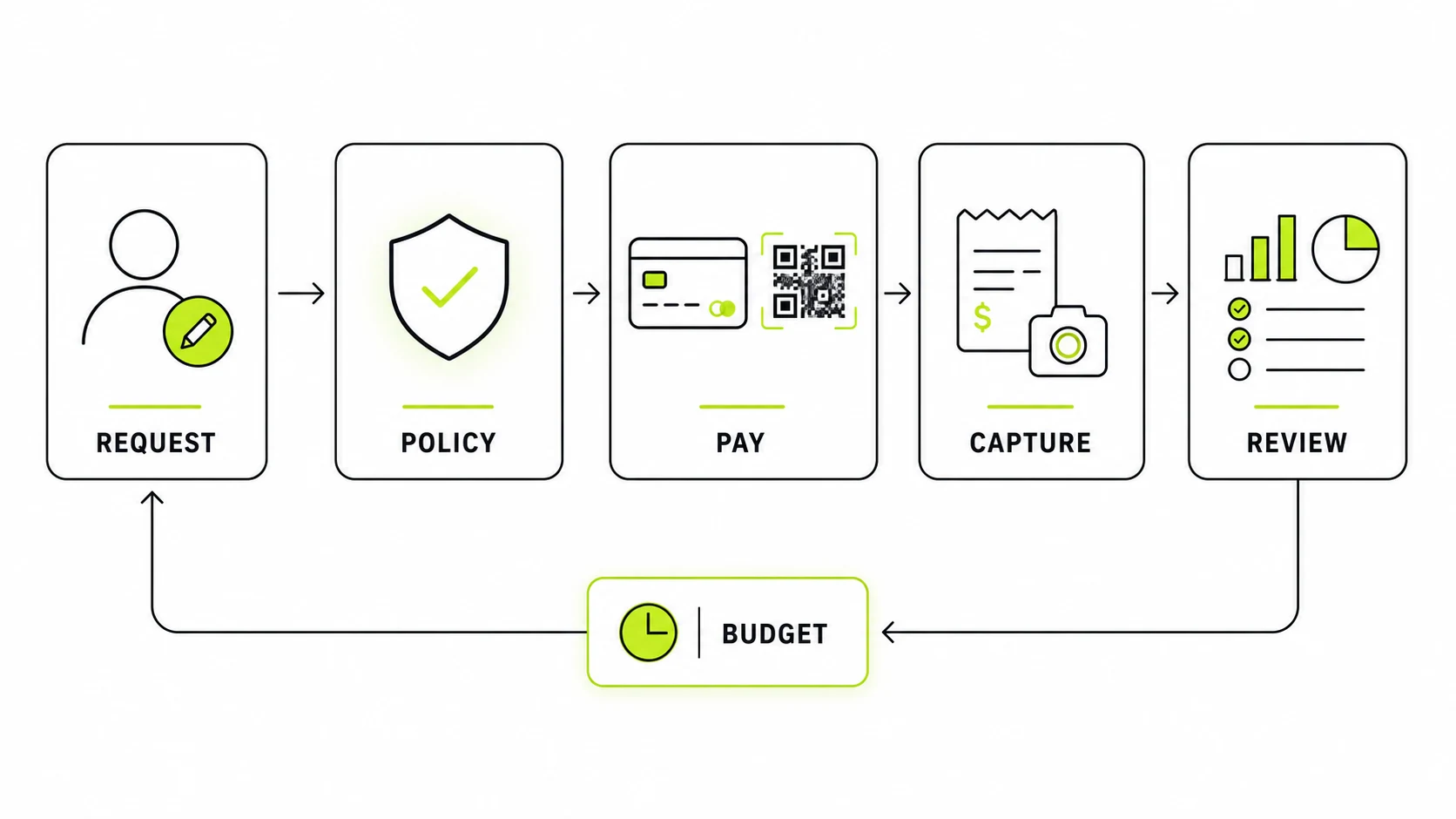
A better workflow begins before money moves. The request should already identify the owner, purpose, budget, payment method, and approval path.
This does not mean every purchase needs a long form. A recurring software subscription can follow a different policy from a one-time vendor payment. A low-risk operational expense can move faster than a large commitment. The goal is to apply the appropriate control for the level of risk.
A practical request contains five pieces of context:
- Who owns the spend? The person and team responsible for the purchase.
- What is it for? A clear business purpose, not a generic description.
- Which budget should fund it? The relevant team, project, or cost center.
- How should it be paid? Card, QRIS, transfer, or reimbursement.
- Who needs to approve it? Based on amount, category, and policy.
Match the payment method to the use case
No single payment method fits every business expense. Control improves when finance defines when each option should be used.
Corporate cards for planned and recurring spend
A dedicated physical or virtual card can be useful for subscriptions, travel, advertising, and team operations. Limits and usage rules should be attached to the card before it is used. A card created for one purpose should not silently become a general company card.
QRIS for fast, local payments
QRIS can make on-the-ground purchasing easier without forcing employees to use personal funds. The important operational step is to capture the merchant, amount, purpose, and receipt while the transaction is still fresh.
Reimbursements for genuine exceptions
Reimbursement remains useful when a company-controlled payment method is not available. It should be an exception path with clear submission requirements, not the default way to finance daily operations.
Transfers for supplier and invoice workflows
Bank transfers may remain appropriate for invoices and established suppliers. They should still be connected to the request, invoice, approver, and budget rather than recorded as an isolated bank movement.
Capture evidence at the moment of spend
The best time to collect a receipt is immediately after a purchase. Delaying evidence creates avoidable follow-up and makes coding less reliable.
An expense workflow should connect the transaction with:
- receipt or invoice;
- merchant and transaction date;
- business purpose;
- category and cost center;
- requester and approver;
- notes needed for audit or month-end review.
AI-assisted receipt extraction can reduce repetitive typing by reading key information from an uploaded image. Finance should still retain review control, especially for exceptions, unclear receipts, or unusual categories.
Route approvals by risk, not habit
A strong approval policy is specific enough to protect the business and simple enough that people can follow it.
Consider routing by:
- amount threshold;
- department or project;
- merchant or spending category;
- recurring versus one-time commitment;
- in-policy versus out-of-policy request;
- availability of receipt and supporting documents.
Low-risk, in-policy transactions can move through a shorter path. Higher-value or unusual requests can receive additional review. This keeps routine work moving while directing finance attention to decisions that genuinely need judgment.
Make budgets operational
A budget should not only explain what happened last month. It should guide the next purchase.
When cards, QRIS payments, expenses, reimbursements, and approvals feed the same budget view, owners can see the impact of a decision before committing more money. Finance can then discuss trade-offs with teams using a shared, current picture instead of reconciling several versions of a spreadsheet.
A useful budget view answers:
- How much was allocated?
- How much has been committed or spent?
- Which transactions are waiting for evidence or approval?
- Who owns the remaining budget?
- Which categories are moving differently from plan?
What a connected week looks like
Imagine an operations team needs to purchase materials for an event.
Monday: The owner submits a request with the event budget, amount, purpose, and preferred payment method.
Tuesday: The request follows the relevant approval rule. Once approved, the owner receives the appropriate company-controlled payment option.
Wednesday: The payment is made. The receipt is uploaded from a phone and connected to the transaction while the context is still clear.
Thursday: Finance reviews only the flagged exception instead of manually reconstructing every compliant purchase.
Friday: The budget owner sees the updated position and can make the next decision using current information.
The result is not less control. It is control placed earlier in the workflow, where it can prevent confusion rather than document it later.
Implementation checklist for finance teams
Use this checklist when moving away from fragmented spend processes:
- Map every payment method currently used by employees and vendors.
- Define an owner and business purpose for every budget.
- Decide which payment method fits each common use case.
- Set approval rules based on amount, category, and risk.
- Require evidence close to the transaction time.
- Separate routine compliant activity from exceptions.
- Review budget movement continuously, not only at month-end.
- Keep a clear audit trail from request through payment and review.
- Train employees on the reason behind each policy.
- Revisit rules when the business or operating model changes.
Frequently asked questions
Does stronger spend control always slow employees down?
No. A well-designed policy can make routine, in-policy purchases faster because the payment method, limit, and approval path are already defined. The slowest processes are often the ones with unclear ownership and repeated follow-up.
Should every expense require the same approval chain?
No. Approval should reflect the risk and context of the transaction. Applying the same chain to every amount and category creates unnecessary work without necessarily improving control.
Can finance keep using spreadsheets?
Spreadsheets remain useful for analysis and planning. The challenge is using them as the live system for requests, payments, evidence, approvals, and budgets at the same time. A connected operating workflow reduces the manual work needed before analysis can begin.
Build control into the workflow
Modern finance operations should give employees practical ways to pay while giving finance clear ownership, policy, evidence, and visibility.
Lign brings company cards, expenses, reimbursements, approvals, QRIS payments, and budgets into a connected workflow designed for how teams operate in Indonesia. The objective is simple: help teams move without losing financial control.